Eating disorders rarely look the way movies and TV shows portray them. Some people with anorexia maintain a body weight that looks “normal” to everyone around them. Some people with bulimia never lose a noticeable amount of weight. Some people with binge eating disorder have never purged in their life. This gap between the stereotype and the reality is exactly why so many people go years without a diagnosis, and why understanding the real types of eating disorders matters so much.
This guide breaks down the three most diagnosed eating disorders: anorexia nervosa, bulimia nervosa, and binge eating disorder, along with the lesser-known conditions clinicians see in practice, such as ARFID and OSFED. You’ll learn what separates one disorder from another, the physical and emotional warning signs to watch for, what actually causes these conditions, and what evidence-based treatment looks like. The information here reflects current clinical guidance from the DSM-5-TR criteria used by psychiatric providers, cross-checked against resources from Mayo Clinic, Johns Hopkins Medicine, and the National Library of Medicine.
Key takeaway: Eating disorders are diagnosable mental health conditions, not lifestyle choices or phases. They affect people of every age, gender, body size, and background, and the earlier they’re identified, the better the odds of full recovery.
What Is an Eating Disorder?
An eating disorder is a mental health condition marked by persistent disturbances in eating behavior, along with distressing thoughts and emotions about food, weight, or body shape. These aren’t simply “picky eating” or occasional overeating — they’re patterns severe enough to damage physical health, disrupt daily functioning, and, in the more severe cases, become life-threatening.
Eating disorders typically involve some combination of:
- Distorted body image or an intense fear of weight gain
- Rigid rules or rituals around food and eating
- Behaviors used to control weight restriction, bingeing, purging, or excessive exercise
- Significant emotional distress tied to eating, food, or appearance
They commonly emerge during the teen and young adult years, though clinicians increasingly diagnose them in children, midlife adults, and older adults as well. And contrary to the old assumption that eating disorders are a “women’s issue,” they occur across all genders.
The Main Types of Eating Disorders (Quick Overview)
| Type | Core Pattern | Body Weight Impact |
|---|---|---|
| Anorexia Nervosa | Severe food restriction driven by fear of weight gain | Often (not always) significantly low body weight |
| Bulimia Nervosa | Cycles of bingeing followed by purging | Often within or near typical weight range |
| Binge Eating Disorder | Recurrent binges without purging | Varies widely; often associated with weight gain over time |
| ARFID | Extreme food avoidance unrelated to body image | Can cause malnutrition or failure to grow, especially in children |
| OSFED | Significant eating disturbance that doesn’t meet full criteria for another type | Varies |
Below, we’ll walk through each in depth.
1. Anorexia Nervosa
What Is Anorexia?
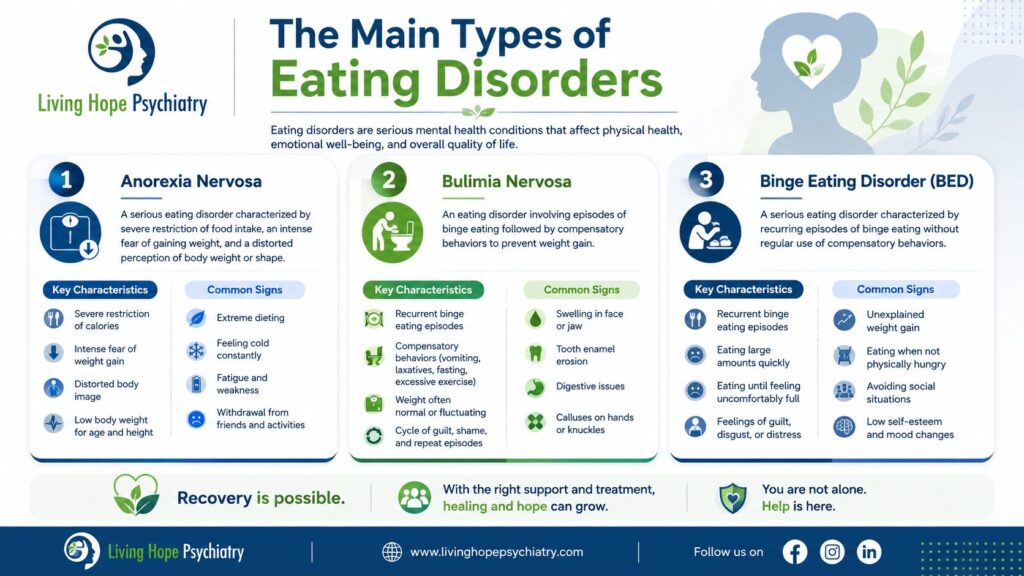
Anorexia nervosa is a psychiatric condition characterized by deliberate restriction of food intake, an intense fear of gaining weight, and a distorted perception of one’s own body size or shape, even when objectively underweight. It’s one of the deadliest mental health conditions, largely due to the medical complications of prolonged starvation.
Signs and Symptoms
- Eating significantly less than the body needs, sometimes cutting entire food groups
- Obsessive calorie counting, food rituals, or rigid meal rules
- Denial of hunger or minimizing the severity of weight loss
- Compulsive or excessive exercise
- Wearing baggy clothing to hide weight loss
- Extreme sensitivity to cold, dizziness, or fainting
- Loss of menstrual periods (in people who menstruate)
- In some cases, use of laxatives, diet pills, or self-induced vomiting alongside restriction
A clinical nuance worth knowing: not everyone with anorexia is visibly emaciated. “Atypical anorexia” describes people who meet all the psychological and behavioral criteria for anorexia but whose weight remains in or above the “normal” range — and it’s more common than most people assume. This is one reason weight alone should never be used to rule an eating disorder in or out.
Health Risks
Anorexia can affect nearly every organ system: heart rhythm abnormalities, bone density loss (osteoporosis), electrolyte imbalances, fertility issues, and cognitive changes from malnutrition. Because the physical risks compound over time, early intervention meaningfully improves outcomes.
2. Bulimia Nervosa
What Is Bulimia?
Bulimia nervosa involves repeated episodes of binge eating, consuming a large amount of food in a short period while feeling a loss of control, followed by compensatory behaviors intended to prevent weight gain. These episodes typically occur at least once a week for three months or longer to meet diagnostic criteria.
Signs and Symptoms
- Eating unusually large amounts of food in a short window, often in secret
- A sense of being unable to stop eating during a binge
- Self-induced vomiting, laxative or diuretic misuse, fasting, or compulsive exercise afterward
- Frequent trips to the bathroom immediately after meals
- Swollen cheeks or jaw (from repeated vomiting)
- Calluses or scarring on the knuckles
- Tooth enamel erosion and dental sensitivity
- Preoccupation with body shape and weight, alongside harsh self-criticism
Health Risks
The purging cycle in bulimia is particularly hard on the body. Repeated vomiting can cause electrolyte imbalances that lead to irregular heartbeat, gastrointestinal damage, chronic sore throat, and dental erosion. Because weight often stays within a typical range, bulimia is frequently missed by friends, family, and even physicians, which is exactly why it’s sometimes called a “hidden” eating disorder.
3. Binge Eating Disorder (BED)
What Is Binge Eating Disorder?
Binge eating disorder is now recognized as the most commonly diagnosed eating disorder in the United States, more prevalent than anorexia and bulimia combined. It involves recurrent episodes of eating large quantities of food accompanied by a felt loss of control, but without the regular compensatory purging seen in bulimia.
Signs and Symptoms
- Eating much faster than usual during a binge
- Eating until uncomfortably full
- Eating large amounts even when not physically hungry
- Eating alone due to embarrassment about quantity
- Feeling intense guilt, disgust, or shame after eating
- Binges occurring at least once a week for three months or more
Health Risks
Because BED isn’t defined by low body weight, it’s often dismissed as a willpower issue rather than a clinical condition, but it carries real medical and psychological consequences, including higher rates of type 2 diabetes, cardiovascular strain, and significant co-occurring depression and anxiety. The shame cycle itself (binge → guilt → isolation → binge again) is often what keeps people stuck without treatment.
Other Types of Eating Disorders You Should Know
Anorexia, bulimia, and BED get the most attention, but they aren’t the only diagnosable eating and feeding disorders. A few others show up regularly in clinical practice:
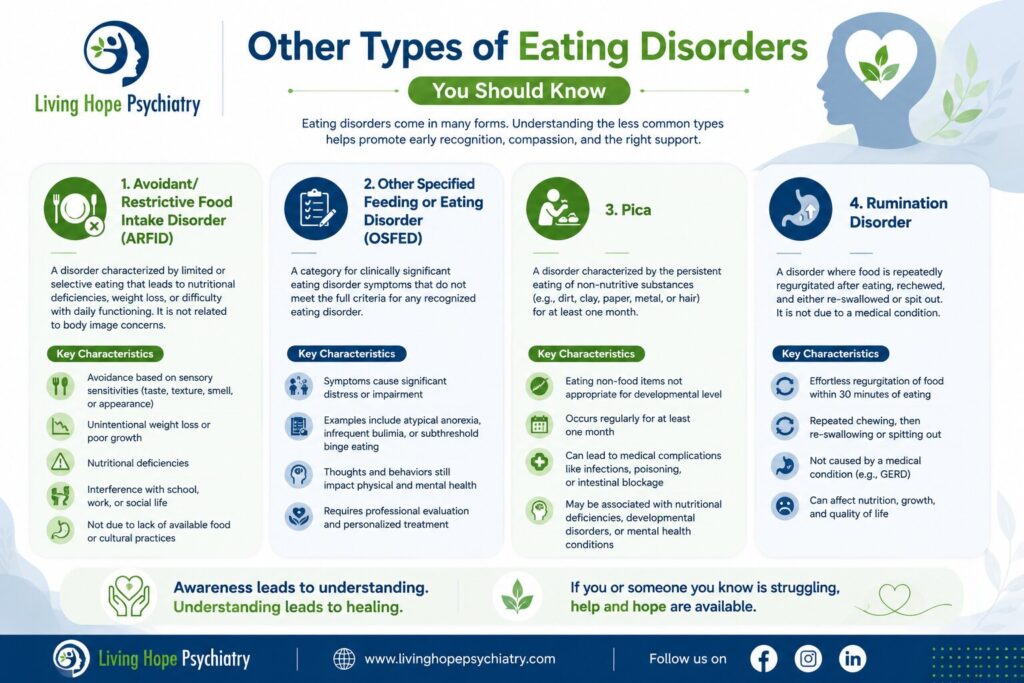
Avoidant/Restrictive Food Intake Disorder (ARFID) Extreme limitation of food intake or avoidance of certain foods, based on sensory sensitivity, low interest in eating, or fear of a negative consequence like choking, without the body image concerns central to anorexia or bulimia. ARFID is diagnosed at any age but appears most often in children and can lead to serious nutritional deficiencies or failure to grow.
Other Specified Feeding or Eating Disorder (OSFED) A diagnosis for eating disturbances that cause real distress and impairment but don’t fully match the criteria for anorexia, bulimia, or BED, for example, bulimia-type behaviors that occur less than once a week, or significant restriction without the fear of weight gain. OSFED is not a “lesser” diagnosis; it’s just as serious and still requires treatment.
Pica Persistent eating of non-food substances (such as chalk, paper, or dirt) for at least one month, in a way that isn’t developmentally normal or culturally sanctioned.
Rumination Disorder Repeated regurgitation of food after eating re-chewing, re-swallowing, or spitting it out, that isn’t due to a medical condition.
Anorexia vs. Bulimia vs. Binge Eating Disorder: What’s the Difference?
This is one of the most common questions people search — and the differences often come down to behavior pattern rather than appearance:
| Feature | Anorexia | Bulimia | Binge Eating Disorder |
|---|---|---|---|
| Restricts food intake | Yes, often severely | Sometimes, between binges | Not typically |
| Binge eating episodes | Uncommon | Yes, regularly | Yes, regularly |
| Purging behaviors | Sometimes | Yes, regularly | No |
| Fear of weight gain | Central feature | Central feature | Present but less central |
| Typical body weight | Often low, but not always | Often typical range | Varies; often above typical range |
| Most associated risk | Malnutrition, organ strain | Electrolyte imbalance, GI/dental damage | Metabolic conditions, depression |
What Causes Eating Disorders?
There is no single cause. Eating disorders develop from an interaction of biological, psychological, and environmental factors:
- Genetics and family history. Having a parent or sibling with an eating disorder increases risk, suggesting a hereditary component.
- Brain chemistry. Differences in neurotransmitter regulation may influence appetite, mood, and impulse control.
- Co-occurring mental health conditions. Anxiety, depression, obsessive-compulsive traits, trauma history, and perfectionism frequently precede or accompany eating disorders.
- Dieting and weight cycling. Restrictive dieting is one of the strongest known risk factors, starvation itself alters brain function in ways that fuel rigid thinking and loss-of-control eating.
- Weight stigma or bullying. Being shamed for body size, including by well-meaning family members or coaches, is strongly associated with disordered eating later on.
- Major life stress or transitions. A new school, a breakup, a move, or a loss can act as a trigger in someone already vulnerable.
Understanding these overlapping causes matters clinically, it’s part of why eating disorders often respond best to integrated care that addresses both the eating behavior and the underlying anxiety, mood, or trauma driving it.
Warning Signs Checklist
Use this as a starting point, not a diagnostic tool — if you’re concerned about yourself or someone you love:
- Skipping meals or making frequent excuses to avoid eating
- Eating in secret or hoarding food
- Disappearing to the bathroom right after meals
- Obsessive focus on calories, macros, or “clean” eating
- Exercising compulsively, even when injured or exhausted
- Noticeable weight changes in either direction
- Withdrawing from meals with family or friends
- Frequent negative comments about weight or body shape
- Dental problems, dizziness, or fatigue with no clear medical cause
- Rigid food rules that interfere with normal life
If several of these apply, regardless of the person’s current weight, it’s worth a conversation with a psychiatric provider.
When to Seek Professional Help
A common misconception is that eating disorder treatment is only necessary once someone is “sick enough” — visibly underweight, medically unstable, or in crisis. In reality, the earlier treatment starts, the shorter and more effective the recovery process tends to be. You don’t need a specific number on a scale to justify getting help; distress and disruption to daily life are enough.
This is also where eating disorders intersect heavily with other conditions we cover often, anxiety, depression, OCD, and trauma responses frequently travel alongside disordered eating. If you’re trying to understand how these conditions overlap, our breakdown of common psychological and behavioral health conditions is a useful next read, as is our look at some of the hardest mental health conditions to live with, which explores why co-occurring diagnoses make treatment more complex, and more important to get right.
How Eating Disorders Are Treated
Effective treatment is rarely one-dimensional. Depending on severity, a treatment plan may include:
- Psychiatric evaluation and medication management — Certain antidepressants and other medications can reduce binge frequency, treat co-occurring anxiety or depression, and support nutritional stabilization.
- Individual therapy — Cognitive behavioral therapy (CBT) is the most evidence-supported approach for bulimia and BED; family-based treatment is often first-line for adolescents with anorexia.
- Nutritional counseling — Working with a dietitian to rebuild a stable, non-fear-based relationship with food.
- Medical monitoring — Especially important for anorexia and bulimia, given the cardiac and electrolyte risks involved.
- Level of care matching — Outpatient support is appropriate for many people; more severe or medically unstable cases may need higher levels of care before stepping down to outpatient management.
At Living Hope Psychiatry, our outpatient team provides psychiatric evaluation, medication management, and coordinated care for eating disorders alongside the anxiety, depression, or trauma that so often accompanies them. You can learn more about our approach on our Eating Disorder Treatment services.
Frequently Asked Questions
What is the most common eating disorder?
Binge eating disorder is now the most commonly diagnosed eating disorder in the U.S., occurring more frequently than anorexia and bulimia combined.
Can you have an eating disorder without being underweight?
Yes. Bulimia, binge eating disorder, atypical anorexia, and OSFED can all occur at typical, above-typical, or below-typical body weights. Weight alone is not a reliable indicator.
What’s the difference between disordered eating and an eating disorder?
Disordered eating refers to problematic patterns — like chronic dieting or occasional binge episodes — that cause distress but don’t meet full diagnostic criteria. An eating disorder is a clinical diagnosis with specific frequency, duration, and severity thresholds. Both deserve attention, but eating disorders typically require structured treatment.
Are eating disorders only about food?
No. While food and weight are the visible focus, eating disorders are fundamentally about control, coping, self-worth, and emotional regulation. This is why therapy and psychiatric care, not just nutrition advice, are central to recovery.
Can eating disorders be cured?
Many people fully recover with appropriate treatment, especially when it starts early. Others manage their condition long-term the way they would any chronic mental health condition, with ongoing support and relapse-prevention strategies.
Do men and boys get eating disorders too?
Yes. Eating disorders affect all genders, though they may present differently, for example, an emphasis on muscularity rather than thinness, and are frequently underdiagnosed in men due to stigma and stereotype.
Key Takeaways
- Anorexia, bulimia, and binge eating disorder are the three most diagnosed eating disorders, but ARFID, OSFED, pica, and rumination disorder are also recognized clinical conditions.
- Body weight alone doesn’t confirm or rule out an eating disorder, behavior patterns and emotional distress matter more.
- Eating disorders develop from a mix of genetic, biological, psychological, and environmental factors, not personal weakness.
- Co-occurring anxiety, depression, and trauma are common and should be treated alongside the eating disorder itself.
- Early intervention consistently leads to better outcomes, regardless of how “severe” a case may currently seem.
Getting Support in McKinney, TX
If any of this sounds familiar in yourself, your child, or someone you love you don’t have to piece together a treatment plan alone. Living Hope Psychiatry provides compassionate, evidence-based outpatient psychiatric care for eating disorders and the anxiety, depression, or trauma that often come with them. Reach out to our McKinney, TX office to schedule an evaluation, or explore our full range of mental health services to see how we can support your recovery.