
Bipolar 1 vs Bipolar 2 can be confusing because both conditions involve significant changes in mood, energy, activity, and functioning. The most important distinction is the type of elevated mood episode a person experiences: Bipolar I includes mania, while Bipolar II includes hypomania and major depressive episodes but no history of a full manic episode.
That distinction matters because mania and hypomania can look similar at first but differ substantially in severity, impairment, duration, and potential consequences.
This guide explains the difference between Bipolar I and Bipolar II, what mania and hypomania look like, how clinicians diagnose each condition, why Bipolar II should not be considered simply a “milder” disorder, and how treatment may differ.
Important: This article is educational and cannot determine whether someone has Bipolar I, Bipolar II, depression, or another condition. Diagnosis requires a comprehensive evaluation by a qualified mental health professional.
Bipolar 1 vs Bipolar 2: The Short Answer
Bipolar I disorder is defined by at least one manic episode. Bipolar II disorder is defined by at least one hypomanic episode and at least one major depressive episode, with no history of mania.
| Feature | Bipolar I | Bipolar II |
|---|---|---|
| Defining elevated episode | Mania | Hypomania |
| Major depressive episodes | Common, but not required for the diagnosis | Required |
| Severity of elevated episode | More severe | Less severe than mania |
| Typical duration of elevated episode | At least 7 days, unless hospitalization is required sooner | At least 4 consecutive days |
| Severe functional impairment | Can be marked | Usually not marked enough to require hospitalization |
| Psychosis during elevated episode | Can occur | Hypomania does not include psychosis |
| Hospitalization | May be necessary during mania | Usually not required for hypomania |
| Can depression be the main problem? | Yes | Often, and it is required for diagnosis |
The central point is simple: Bipolar I requires mania; Bipolar II requires hypomania plus major depression.
What Is Bipolar I Disorder?
Bipolar I disorder is a mood disorder characterized by episodes of mania, often accompanied by episodes of major depression.
A manic episode involves a distinct period of unusually elevated, expansive, or irritable mood together with increased energy or activity. The change is significant enough to cause substantial impairment, require hospitalization, or involve psychotic symptoms.
Common symptoms of mania
Someone experiencing mania may:
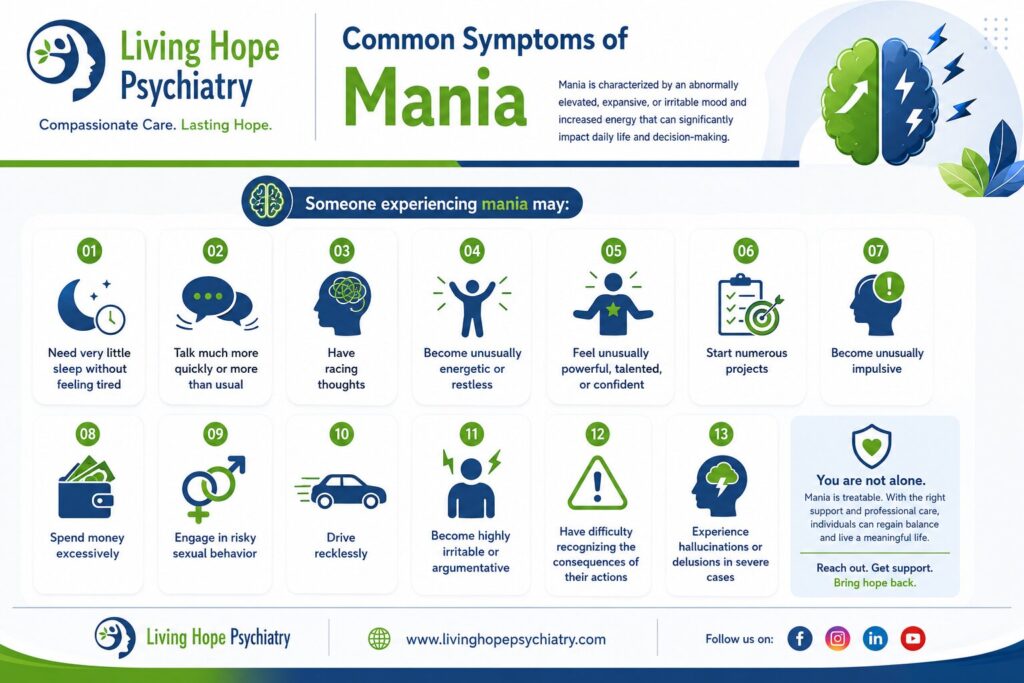
- Need very little sleep without feeling tired
- Talk much more quickly or more than usual
- Have racing thoughts
- Become unusually energetic or restless
- Feel unusually powerful, talented, or confident
- Start numerous projects
- Become unusually impulsive
- Spend money excessively
- Engage in risky sexual behavior
- Drive recklessly
- Become highly irritable or argumentative
- Have difficulty recognizing the consequences of their actions
- Experience hallucinations or delusions in severe cases
Mania can significantly disrupt work, relationships, finances, education, and personal safety.
How long does mania last?
Under current diagnostic criteria, a manic episode generally lasts at least seven days when hospitalization is not required earlier. Severe symptoms may lead to hospitalization before seven days.
A person does not need to experience depression to meet the basic diagnostic definition of Bipolar I. The presence of a qualifying manic episode is the key diagnostic feature.
What Is Bipolar II Disorder?
Bipolar II disorder involves a pattern of:
- At least one hypomanic episode
- At least one major depressive episode
- No history of a manic episode
Hypomania resembles mania but is less severe. The person experiences a noticeable change in mood, energy, and activity, but the episode does not reach the level of full mania.
This is one reason Bipolar II can be overlooked. A person may seek treatment because of severe depression while viewing periods of increased energy or reduced sleep as simply being productive, motivated, or unusually confident.
Common symptoms of hypomania
During hypomania, someone may:
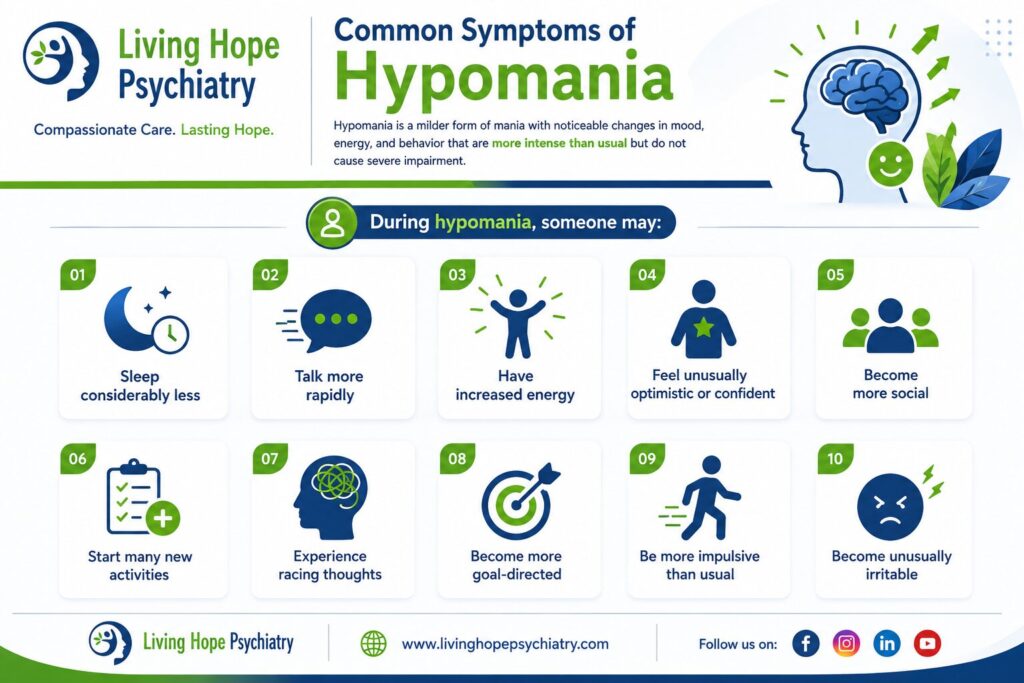
- Sleep considerably less
- Talk more rapidly
- Have increased energy
- Feel unusually optimistic or confident
- Become more social
- Start many new activities
- Experience racing thoughts
- Become more goal-directed
- Be more impulsive than usual
- Become unusually irritable
The symptoms are real and clinically important, even though hypomania is less severe than mania.
Mania vs Hypomania: The Difference That Defines Bipolar I and II
The distinction between mania and hypomania is the most important concept when comparing Bipolar I and Bipolar II.
| Mania | Hypomania |
|---|---|
| More severe | Less severe |
| Causes marked impairment or may require hospitalization | Does not cause marked impairment |
| Can include psychosis | Psychosis means the episode is manic, not hypomanic |
| Can seriously disrupt work and relationships | Functioning may remain relatively intact |
| Usually lasts at least 7 days unless hospitalization occurs sooner | Lasts at least 4 consecutive days |
| May involve dangerous or highly impulsive behavior | May involve noticeable behavioral changes without severe impairment |
A common misconception is that hypomania is simply “mild mania.” Clinically, the distinction involves more than intensity. The degree of functional impairment, duration, psychotic symptoms, and overall presentation are important.
Why Bipolar II Is Not Simply “Bipolar I Lite”
This is an important point that is often missed in discussions about Bipolar 1 vs Bipolar 2.
Because Bipolar II does not include full mania, some people assume it is automatically a mild form of bipolar disorder. That is misleading.
People with Bipolar II can experience substantial and prolonged depressive symptoms, and depression can significantly affect relationships, employment, concentration, motivation, and quality of life. NIMH notes that many people with Bipolar II spend extended periods experiencing depressive symptoms.
The difference between the diagnoses is therefore not simply:
“Severe bipolar” vs. “mild bipolar.”
It is primarily about the pattern and severity of mood episodes.
Bipolar I vs Bipolar II Symptoms
Both disorders can involve:
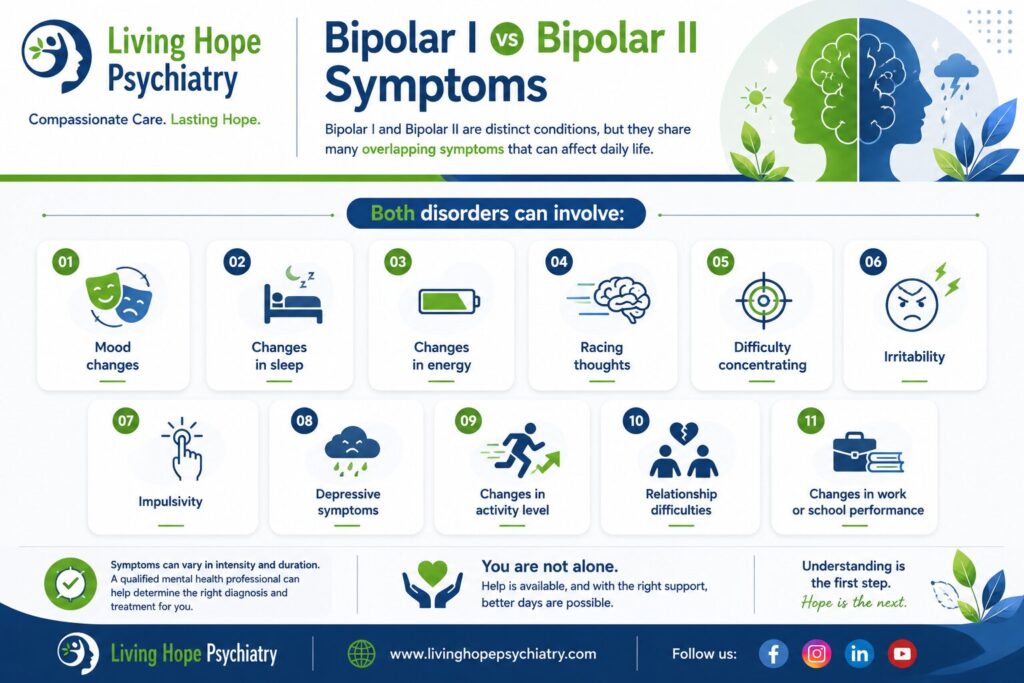
- Mood changes
- Changes in sleep
- Changes in energy
- Racing thoughts
- Difficulty concentrating
- Irritability
- Impulsivity
- Depressive symptoms
- Changes in activity level
- Relationship difficulties
- Changes in work or school performance
The difference is the elevated mood episode.
Bipolar I
Mania + possible major depression
Bipolar II
Hypomania + major depression + no mania
This distinction is particularly important when someone presents with depression.
A person who has been treated repeatedly for depression may have an underlying bipolar-spectrum condition that has not yet been recognized. Clinicians therefore consider the person’s lifetime mood history, rather than evaluating only their current depressive symptoms. NIMH emphasizes that diagnosis considers symptom severity, duration, frequency, lifetime history, and family history.
Bipolar I vs Bipolar II: Real-World Examples
Example 1: Bipolar I
Imagine someone who normally sleeps seven hours but suddenly sleeps only two or three hours for several nights and still feels extremely energetic.
They begin talking rapidly, spend large amounts of money, become unusually confident, make risky decisions, and become increasingly irritable. Their behavior becomes disruptive enough that family members seek emergency help, and hospitalization becomes necessary.
This pattern may be consistent with mania, which is the defining feature of Bipolar I.
Example 2: Bipolar II
Another person experiences several days of unusually high energy. They sleep less, talk more, feel highly productive, begin multiple projects, and seem noticeably different to family members.
However, they remain able to work and do not develop severe impairment or psychotic symptoms.
Several months later, they experience a prolonged depressive episode with low motivation, loss of interest, difficulty concentrating, hopelessness, and significant functional problems.
This pattern may be consistent with Bipolar II, although only a qualified clinician can make the diagnosis.
Bipolar Depression Can Make Bipolar II Difficult to Recognize
One of the most clinically important differences is how the disorder may come to someone’s attention.
A person experiencing Bipolar II may seek help during a depressive episode because depression is causing the greatest immediate distress. Hypomania may not feel problematic to the individual, particularly if it is associated with productivity, confidence, sociability, or increased energy.
NIMH specifically notes that people with Bipolar II may seek help for depression while hypomanic episodes go unnoticed.
That makes a detailed history especially important.
Questions clinicians may explore
A mental health professional may ask:
- Have there been periods when you needed much less sleep?
- Did you feel unusually energetic during those periods?
- Did other people notice that you were acting differently?
- Did you talk much faster than usual?
- Did you become unusually confident or outgoing?
- Did you spend more money than usual?
- Did you take risks you normally would not take?
- How long did these changes last?
- Did these periods cause serious problems?
- Has anyone in your family had bipolar disorder?
- Have medications, substances, or medical conditions affected your mood?
These questions help establish the longitudinal pattern rather than focusing on one isolated symptom.
How Is Bipolar I or Bipolar II Diagnosed?
There is no single blood test, brain scan, or laboratory test that independently confirms Bipolar I or Bipolar II.
Diagnosis involves a comprehensive psychiatric assessment.
A clinician may evaluate:
1. Lifetime mood history
The clinician looks for previous manic, hypomanic, and depressive episodes.
2. Episode duration
How long did the mood and behavior changes actually last?
3. Functional impact
Did the episode interfere with work, school, relationships, finances, or daily responsibilities?
4. Sleep and energy changes
Reduced need for sleep can be particularly important when evaluating possible mania or hypomania.
5. Psychotic symptoms
Hallucinations or delusions can occur during severe mood episodes. Psychosis during an elevated episode indicates mania rather than hypomania.
6. Medications and substances
Some medications and substances can mimic or worsen mood symptoms, so clinicians may review prescriptions, recreational substances, and other relevant exposures.
7. Medical conditions
Certain medical conditions, including thyroid problems, can produce symptoms that resemble mood disorders.
8. Family history
A family history of bipolar disorder or other psychiatric conditions can provide useful diagnostic context.
Bipolar I vs Bipolar II Treatment
Treatment is individualized. There is no single medication or therapy that works identically for every person with bipolar disorder.
Treatment may include:
- Mood-stabilizing medication
- Atypical antipsychotic medication
- Psychotherapy
- Sleep and daily-routine management
- Substance-use treatment when needed
- Education about early warning signs
- Long-term monitoring
NIMH notes that bipolar disorder is commonly treated with medication, psychotherapy, or a combination. Medication options can include mood stabilizers and atypical antipsychotics, while treatment may vary depending on whether someone is experiencing mania, depression, or maintenance needs.
Why treatment should be individualized
The best treatment approach depends on factors such as:
- Current mood episode
- Previous episodes
- Medication response
- Side effects
- Co-occurring conditions
- Sleep patterns
- Substance use
- Pregnancy considerations
- Suicide risk
- Medical history
A particularly important consideration is that antidepressant treatment requires careful clinical assessment in bipolar disorder. NIMH notes that antidepressants are generally not used alone in bipolar disorder because they can contribute to manic episodes or rapid cycling in some people.
Never start, stop, or change psychiatric medication without discussing it with the prescribing clinician.
Bipolar I vs Bipolar II and Psychosis
Psychosis can occur in bipolar disorder, particularly during severe mood episodes.
Symptoms can include:
- Hallucinations
- Delusions
- Loss of contact with reality
A key diagnostic distinction is that psychosis is incompatible with a hypomanic episode. If psychotic symptoms occur during an elevated episode, the episode meets the definition of mania rather than hypomania.
Psychotic symptoms can also occur during severe depressive episodes.
Can Bipolar I Become Bipolar II?
This question is often misunderstood.
The diagnoses are based on the person’s history of mood episodes. A person who has experienced a true manic episode meets the defining criterion for Bipolar I; a later period of less severe elevation does not erase that history.
Early in the course of illness, however, the full pattern may not yet be clear. NIMH experts note that identifying the correct bipolar subtype can sometimes take time as the person’s symptoms and history become clearer.
That is one reason ongoing assessment can be valuable.
What Bipolar I and Bipolar II Have in Common
Despite their differences, both conditions can be serious.
Both may involve:
- Episodes of depression
- Elevated or irritable mood
- Sleep disruption
- Changes in energy
- Impulsivity
- Difficulty concentrating
- Relationship problems
- Occupational difficulties
- Anxiety or substance-use problems
- Risk of suicidal thoughts or behavior
Bipolar disorder is also often episodic, meaning symptoms can change substantially over time. NIMH describes bipolar disorder as a condition that can be chronic or episodic and notes that appropriate treatment can improve functioning and quality of life.
Bipolar I vs Bipolar II vs Cyclothymia
It is also useful to distinguish both conditions from cyclothymic disorder.
| Condition | Main pattern |
|---|---|
| Bipolar I | At least one manic episode |
| Bipolar II | Hypomanic episodes + major depressive episodes, without mania |
| Cyclothymic disorder | Recurrent hypomanic and depressive symptoms that do not meet full episode criteria |
Cyclothymic disorder involves recurrent mood symptoms that are not sufficiently severe or long-lasting to qualify as full hypomanic or depressive episodes.
Common Misunderstandings About Bipolar 1 vs Bipolar 2
“Bipolar II is just a mild version of Bipolar I.”
Not necessarily. Hypomania is less severe than mania, but Bipolar II can involve substantial depressive illness and functional impairment.
“Someone with bipolar disorder is always either extremely happy or extremely sad.”
Not necessarily. Bipolar disorder is episodic, and symptoms can vary substantially between episodes.
“Reduced sleep always means mania.”
No. Sleep loss can have many causes. What matters is the broader pattern, including changes in mood, energy, activity, behavior, duration, and impairment.
“Being productive means you are hypomanic.”
Not automatically. Hypomania involves a distinct change from a person’s usual functioning and includes specific mood and behavioral symptoms.
“You can diagnose bipolar disorder from a checklist.”
A checklist can identify symptoms worth discussing, but diagnosis requires clinical judgment and consideration of the person’s complete history.
When Should You Seek a Bipolar Disorder Evaluation?
Consider talking with a mental health professional if you or someone close to you experiences recurring periods of:
- Very little sleep without feeling tired
- Unusually high energy
- Racing thoughts
- Rapid speech
- Extreme irritability
- Unusual impulsivity
- Excessive spending
- Risk-taking
- Significant depressive episodes
- Major changes in functioning
- Mood episodes that others notice as dramatically different from your usual personality
A particularly useful step is to document when symptoms started, how long they lasted, changes in sleep, medications, substance use, and changes noticed by family or friends.
That information can make a psychiatric evaluation much more informative.
A Practical Checklist for Tracking Possible Mood Episodes
If you are preparing for an appointment, consider keeping a simple record of:
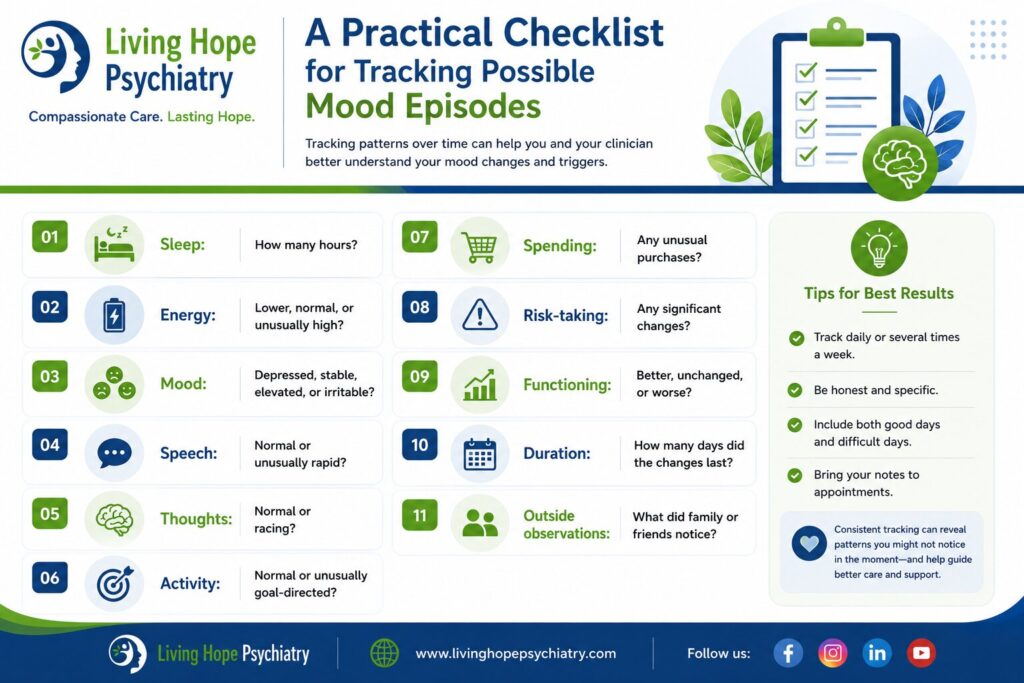
- Sleep: How many hours?
- Energy: Lower, normal, or unusually high?
- Mood: Depressed, stable, elevated, or irritable?
- Speech: Normal or unusually rapid?
- Thoughts: Normal or racing?
- Activity: Normal or unusually goal-directed?
- Spending: Any unusual purchases?
- Risk-taking: Any significant changes?
- Functioning: Better, unchanged, or worse?
- Duration: How many days did the changes last?
- Outside observations: What did family or friends notice?
A mood journal cannot diagnose bipolar disorder, but it can help a clinician understand patterns that may be difficult to remember accurately months later.
Key Takeaways: Bipolar 1 vs Bipolar 2
- Bipolar I is defined by mania.
- Bipolar II is defined by hypomania and major depression.
- Mania is more severe than hypomania and can cause marked impairment, hospitalization, or psychosis.
- Bipolar II is not simply “mild bipolar disorder.”
- Depression can be a major source of disability in both conditions.
- Diagnosis requires looking at the person’s long-term pattern of symptoms, not just their current mood.
- Treatment may involve medication, psychotherapy, lifestyle strategies, education, and ongoing monitoring.
- A qualified mental health professional should make the diagnosis and treatment plan.
FAQs:
Is Bipolar I worse than Bipolar II?
Neither diagnosis should be reduced to simply “worse” or “better.” Bipolar I is distinguished by the presence of mania, which can become extremely severe and require hospitalization. Bipolar II does not involve full mania but can involve significant and prolonged depression.
Can Bipolar II turn into Bipolar I?
If someone with a previous Bipolar II diagnosis later experiences a qualifying manic episode, the diagnosis would be reconsidered because a history of mania meets the defining criterion for Bipolar I. Early diagnostic uncertainty can occur when a person’s lifetime pattern has not yet become clear.
What is the biggest difference between Bipolar I and Bipolar II?
The defining difference is mania versus hypomania. Bipolar I requires at least one manic episode. Bipolar II requires hypomania and major depression without a history of mania.
Can someone with Bipolar II have severe depression?
Yes. Depression can be a major part of Bipolar II and may cause substantial difficulties with functioning and quality of life.
Can Bipolar I or II be treated?
Yes. Bipolar disorder can be managed with individualized treatment. Depending on the person’s symptoms and circumstances, treatment may involve medication, psychotherapy, or both.
How can I tell whether I have Bipolar I or Bipolar II?
You cannot reliably determine the subtype from symptoms alone or from an online quiz. A psychiatrist or other qualified mental health professional will evaluate your lifetime history of mood episodes, including their duration, severity, functional effects, sleep changes, medications, substances, medical conditions, and family history.
Finding the Right Support
Understanding the difference between Bipolar 1 vs Bipolar 2 is an important first step, but recognizing a pattern does not replace a professional assessment. The most useful evaluation looks beyond a single depressive or energized period and considers how mood, sleep, energy, behavior, and functioning have changed over time.
Living Hope Psychiatry provides mental health care for individuals seeking professional support, including evaluation and treatment planning. If you are considering psychiatry McKinney services, discussing your complete mood history with a qualified clinician can help determine what type of care is appropriate.